Tuesday, June 26, 2012

Well another day has gone in Mycenae. Soon the sun will be setting over the mountains and I'll be eating ice cream in a cafe. Oh wait, no I don't think I can call it a cafe. It's more like a shed with a freezer full of ice cream. But it is good ice cream, and it's even better when it's warm out, and it has been very warm today.
Working in a trench with no afternoon shade is difficult, to put it mildly. It's hot, your hat does't really help and you're grateful for whatever breeze floats your way, even though the breeze tends to also blow dust in your face, which turns into mud everywhere you've been sweating. The sun is shining so brightly it reflects off the soil and into your eyes and you can't look at white paper without either being in the shade or having on sunglasses, with both of those being the preferred method, but occasionally neither is available. Thankfully this usually only lasts for a couple hours at the end of the day.
Today, though, felt like an oven and I was thankful to be in the much cooler area of Nemea. My trench partner, however, let me hear it, as did those who filled in for me. I feel bad, but at the same time very grateful for having missed it. As much as I love archaeology, there are definitely parts that I am not particularly fond of, and direct sunlight with no breeze at 95 degrees is one of those parts.
I don't know what they dug up today, but I enjoyed being a nerd in the museum again. It was a bit more intensive this time, and my professor and I figured out a worksheet to make our work a bit easier and efficient, hooray! This is while we were drinking fresh Greek (aka Turkish) coffee and looking over the ruins of the Temple of Nemean Zeus in the shade and a relatively cool 80 degrees.
This is also something my trench mate did not enjoy hearing too much of. I know it's friendly banter, and I do wish she could come with, but alas, it'll be another week and half before we work together in the cool museum. And then she'll get her Greek coffee too.

Thursday, June 21, 2012

Well, museum work is a lot of fun, and a nice break from the back-breaking labor of the past few days. Today I was sorting and cataloguing, the latter of which entails taking several pieces from a lot that are either indicative of the whole collection or really outstanding pieces that will help to date the finds. Preferably each catalogued piece is both. I did that after sorting out a lot of sherds.
You see, pots break easily. I'm sure everyone's dropped a plate on the kitchen and wham! A hundred pieces. If you were to look at those you could discover a few things. If you were to break one and look at the pieces right now that could be called experimental archaeology and we really do stuff like that. It's a lot of fun. However, the other members of your household might not appreciate you breaking plates for the sake of science.
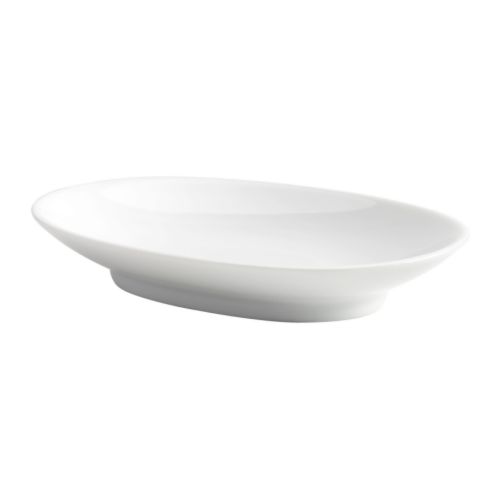
The Epistel Serving Plate from IKEA. No, this is not an endorsement. It just shows everything I want it to.
But looking at the pieces you can see rounded edges in two places if it's a normal plate: along the upper rim, and along the base. You get a triangular profile for the upper rim, usually identified as just rim, and the base should more or less stand up somehow, but that is highly dependent on the base. This one is probably raised in the middle. If you look at a lot of pottery, they tend to be flat along the bottom, with a vertical edge. The other pieces are body sherds.
The things you can learn from these sherds (remember: pieces of pottery): what type of vessel it is. Here we have an open vessel that is undecorated with a raised base that overall is rather flat, aka a plate. You can also take the base if it's unbroken and get a good estimate for how wide the diameter is.
Sorting is separating all of those pieces to get an idea of about how many vessels could be in the collection.
And there is your archaeology lesson for the day! Now imagine taking away 90-99% of those pieces and putting together that information. That was what I did all day and it was fun. It's like a puzzle with pieces from different boxes all thrown into a Ziploc bag and no nice cover art to help you. You generally have no idea how much of a pot (or plate, bowl, etc.) you have.
This is more like what I was working with today, or at least the pretty stuff. The rest was very utilitarian and rather boring.
Here's where this one is from

And that is museum work for you. It's usually even less glamorous than field work, but also usually a lot less sweaty. Besides, I enjoy the paperwork so it almost felt like a field trip.

Wednesday, June 20, 2012

Ok, so two days in the field and I am sore. Really, really sore. But it has been a lot of fun. We're digging a deep square hole right now. It started as a joke, because that's what you do in archaeology, but not always, or not necessarily. This time it's really almost a 2 meter deep hole. We don't know what it is. It doesn't seem to have enough stuff in it for a well, and the bedrock is only on three sides, and not four, like a typical well. It also has a vertical concave depression on one side, making it more confusing. Suggestions anyone?
But, at the end of today there are currently several large pot sherds (pieces of pottery) poking out of the ground. As much as we just want to yank them out, we can't. You have to dig in an even and level manner to retain the context and important information that can be contained therein. Say you find pottery from one period in one level, and it changes in another level, it's telling you that you're digging from two separate time periods. It's simple, but important to know. 
And enough archaeology. We didn't get to see the citadel of Mycenae yet because it was closed on Sunday due to the elections. I'll have to truck up there one of these days just for you guys.
By the way, you won't be seeing any pictures of the sites themselves. Sorry! Since none of the work has been published I can't post anything online of what we're doing. Boss's orders.
So I'm sure you're interested in Greece. It's really pretty. There are mountains and shrubs and a few pine trees. It seems like there is constantly wind, but that might be the season. There are orange and apricot groves all over, and vineyards and olive groves cover the slopes. Well, they cover the slopes around different archaeological sites. All of the groves are privately owned and the government owns the land where the sites are (some of the time) so the trees come right up to the tombs. The people are really friendly but the shop owners holler at you to eat at their restaurant over the other guy's. The fruit and food is delicious. It's so fresh! I'll remember to take pictures of the food as I go along. I've just been lazy and forgetting my camera.
Alright, well, I promised pictures and here you are! Tidbits of Mycenae, Greece. I hope you enjoy!
I have no idea what this sign says but it's pointing to a Mycenaean bridge.


Here's the bridge from about 20 ft away

This is the bridge from the road


The exterior of the Tomb of Atreus
It is a tholos tomb in rather good condition
This is at the outside of the dromos, or walkway
The interior of the dome of the tholos
These pretty purple flowers are pretty prevalent on the sides of the roads
Baby olives! They are everywhere!
Literally! All along the road and everything!
And there are strays everywhere in town. This one is apparently Barry.
He enjoyed a good pork bone yesterday, courtesy of on of the guys.
P.S. The Tomb of Atreus is not necessarily Atreus's tomb. It's just called that because we don't know who was in it. All of the tholos tombs in the vicinity of Mycenae were robbed in antiquity so we don't even know what sort of grave goods they contained.

Saturday, June 16, 2012


Well hey! I made it to Greece. I am now officially a world traveler, even if it’s only been once. The trip wasn’t too bad, except for almost missing my flight to Athens from Toronto because of a security breach and then the guy behind me snoring loud enough to wake up Beethoven two hours into a ten-hour flight. But there was a cute baby boy who kept eyeing me and my seat mate was pretty cool, so it more or less evens out I think.
Sorry I don’t have any pictures up yet. It’s been a long day and while I took some, they still need to be uploaded and its too much work right now. I have Greek phrases running through my head, and pictures of their alphabet dancing behind my eyes. I miss home already, but we’re not doing anything yet, so I can’t complain. I’m sure it’ll lessen pretty soon, and then I’ll be missing Greece when I get back.
I’m so excited to work though! I mean, this is firsthand experience in my chosen field. Butterflies? Yes, like crazy! Excited? Well, of course. I find it odd and confusing when people no longer want to learn. I feel as if something’s missing from my life when I’m not in the process of learning something. I want to continually be growing and to feel stretched outside of my comfort zone. This is probably the biggest test of that.
And seeing as how I’m doing this for course credit, hopefully I pass and enjoy it as much as I’ve hoped I will. I’d hate to change career plans this far in. I don’t think I’m very well suited for business or engineering. I may have a better chance in photojournalism. Hmm… that might mean investing in more camera gear.
The best news so far, however, involves free beer. When one of the restaurant owners heard we were on the excavation team, he offered us a free beer everyday we learned a new word in Greek. I call that a swell deal. And the food was pretty awesome. 
Oh and everything on my blog is showing up in Greek over here, except for what I'm writing. Go figure, eh?

Monday, June 11, 2012

Well, less than a week to go and I still have so much to do! I need to call my grandmothers, my sister, my brother, get a hair cut, sim card, outlet converters and transformers, find another pair of shorts and a swimsuit, and I know I'm missing something. Oh yeah, that's right. I need to pack.

But I'll concern myself with that after some ice cream. There's that part of me that says I should call in sick the next couple days, and then the part of me (my wallet) that says I need to work since I won't be making any money for over a month. Ah Responsibility. Sometimes you get in the way of this thing called Enjoyment, although you are help to Preparation and the Real World. I do believe we have a love/hate relationship.

Well, with the trip being so close, other Real World concerns have been brought to mind, things greater than just myself. Greece is at another turning point in its long history. Already there has been some theft (here) since the economic crisis has left fewer people to guard the museums. We already saw what happened in Cairo.


Is that what could happen in Greece? The situations are very different, and the unrest has different causes. However, unrest is still unrest. It seems like whenever there's a major change in an area, antiquities go missing (Iraq anyone?), not to mention the damage caused to ancient monuments (WWII bomber planes did open up the Sanctuary of Fortuna at Praeneste even though they destroyed the medieval buildings surrounding it; the Ziggurat of Ur was also damaged in the First Gulf War; etc.).

Sanctuary of Fortuna at Praeneste directly after the bombing in WWII
Reconstructed Ziggurat of Ur
Source Page
It very well could be what happens, especially if other countries in the European Union head down that road. It's in humanity's nature to take advantage of situations and profit by any means necessary. Again, however, there is also an urge to break away from the perceived causes of the destabilization. In Ancient Greece, after the Mycenaean culture fell, there was a destabilized period called the Dark Age (currently undergoing a name revision by Classicists). During this period iron became more prevalent than bronze, and thus began the Iron Age. This is interesting because iron is much more difficult to work than bronze and is thought to have two causes: the relative abundance of iron in Greece and a lack of tin (essential to producing bronze), and that it possibly represented a break with the Mycenaean culture. After a couple hundred years, bronze came back into fashion for luxury goods, possibly echoing a supposedly heroic past.

So we have people who want to take advantage of a situation, say fewer police and guards, and those who aren't thinking clearly because they're angry and upset at the government. We also have those who are thinking clearly and are looking at ways to increase income to help run their new government. Really, the selling of antiquities in a country full of them is a great way for quick cash, and forget the antiquities laws. Rules get bent and stretched constantly, and it isn't only museums and public collections that wish to acquire. It's far easier to sell to a private consumer. There's way less paperwork and scrutiny, lowering by far the chances of getting caught. Whom wouldn't this appeal to?

I really hope none of this happens. I really, really hope none of this happens while I'm there. I'm sure it won't, and that I'm just over-thinking this. If not, I'll instigate plan B, hop on a cargo boat to Italy and fly out of Rome and back home. Or something like that.

Monday, June 4, 2012

Archaeology, as a field, can aptly be described as one that began as a treasure hunt. People wanted the gold of the past, the great statues and marbles that stirred faint echoes of former greatness. Granted, these adventurers sometimes took painstakingly detailed drawings before they used dynamite to enter a pyramid, but not always. In fact, not usually. Archaeology is generally thought of as becoming a science when excavations were carried out with record-keeping being as much of a priority as finding treasure. The field progressed with intensive record-keeping and meticulous detail work, and went further when the  goal was no longer the glittering gold of ancient kings.
This probably sounds like the end of a romantic dream. Victorian men going out in bucket hats with the goal of finding something, really just anything of value to bring back to the Queen for the glory of their country sounds so much better than looking for pieces of pottery (a.k.a. pot sherds) to be able to accurately date a site. Aren't statues and gold better than dust and stones? Seriously, what gives?
It was slowly realized that a lot of valuable information about the past was being lost, and that many early excavations were the modern equivalent of looting, even if it was done with the permission of the governments involved (and there are times when it was not). Flinders Petrie was one of the first to demand a meticulous approach to excavation. Heinrich Schliemann was part of the note-taking revolution as well. Interestingly enough, neither man was well-liked by the scientific community at first since neither had had any formal training in the field.
Scientists really seem to be stuffy old intelligent fools stuck in their ways. And I want to be one of those? No. I do have my husband, and friends, around to bring me back to reality and knock me down a few pegs when necessary.
So why is attention to detail deemed so necessary? Why can't we just look at the temples, tomb paintings, statuary and gold relics to understand history and prehistory?
Look around your house briefly, and I will illustrate my case in point. Do you see large statues, items of gold laying around, or precious ceremonial objects? Do you see large quantities of them if you see any at all? Sure I have a few pieces of silver plate, and several antiques of small value. Most of us have a few old things. Most of us have a few valuable things. However, these are not what make up our daily lives. This analogy can be drawn to the past. Most of them did not have great status, or the luxury goods that accompanied it. It's hard to fully understand the past when you're looking only at the glitzy obvious parts. It requires more digging, literally and figuratively.
An example that brought this whole topic to mind can be found here. Careful analysis of the bones discovered in the Neolithic graves has revealed what could be the beginnings of hereditary inequality. But the story doesn't stop there. In the strontium isotope analysis of the bones of the women, it was found that theirs differed significantly from those of the men, indicating that they did not originate from that locality. This has led the researchers to believe that this group was patrilocal, or that women moved out of the family group to marry others, and that men brought women into the village to marry. Or, if not marry in the modern sense, at least to bear their children.
That is not romantic archaeology. It's science and investigative research. And it is vitally necessary to our understandings of the past. Let's just not be stuffy about it.