Well, museum work is a lot of fun, and a nice break from the back-breaking labor of the past few days. Today I was sorting and cataloguing, the latter of which entails taking several pieces from a lot that are either indicative of the whole collection or really outstanding pieces that will help to date the finds. Preferably each catalogued piece is both. I did that after sorting out a lot of sherds.
You see, pots break easily. I'm sure everyone's dropped a plate on the kitchen and wham! A hundred pieces. If you were to look at those you could discover a few things. If you were to break one and look at the pieces right now that could be called experimental archaeology and we really do stuff like that. It's a lot of fun. However, the other members of your household might not appreciate you breaking plates for the sake of science.
But looking at the pieces you can see rounded edges in two places if it's a normal plate: along the upper rim, and along the base. You get a triangular profile for the upper rim, usually identified as just rim, and the base should more or less stand up somehow, but that is highly dependent on the base. This one is probably raised in the middle. If you look at a lot of pottery, they tend to be flat along the bottom, with a vertical edge. The other pieces are body sherds.
The things you can learn from these sherds (remember: pieces of pottery): what type of vessel it is. Here we have an open vessel that is undecorated with a raised base that overall is rather flat, aka a plate. You can also take the base if it's unbroken and get a good estimate for how wide the diameter is.
Sorting is separating all of those pieces to get an idea of about how many vessels could be in the collection.
And there is your archaeology lesson for the day! Now imagine taking away 90-99% of those pieces and putting together that information. That was what I did all day and it was fun. It's like a puzzle with pieces from different boxes all thrown into a Ziploc bag and no nice cover art to help you. You generally have no idea how much of a pot (or plate, bowl, etc.) you have.
This is more like what I was working with today, or at least the pretty stuff. The rest was very utilitarian and rather boring.
And that is museum work for you. It's usually even less glamorous than field work, but also usually a lot less sweaty. Besides, I enjoy the paperwork so it almost felt like a field trip.
You see, pots break easily. I'm sure everyone's dropped a plate on the kitchen and wham! A hundred pieces. If you were to look at those you could discover a few things. If you were to break one and look at the pieces right now that could be called experimental archaeology and we really do stuff like that. It's a lot of fun. However, the other members of your household might not appreciate you breaking plates for the sake of science.
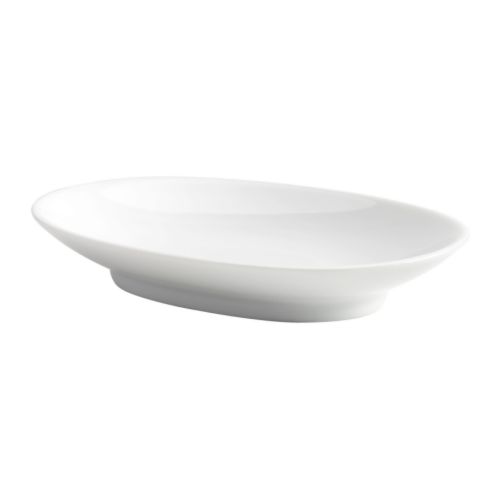 |
| The Epistel Serving Plate from IKEA. No, this is not an endorsement. It just shows everything I want it to. |
The things you can learn from these sherds (remember: pieces of pottery): what type of vessel it is. Here we have an open vessel that is undecorated with a raised base that overall is rather flat, aka a plate. You can also take the base if it's unbroken and get a good estimate for how wide the diameter is.
Sorting is separating all of those pieces to get an idea of about how many vessels could be in the collection.
And there is your archaeology lesson for the day! Now imagine taking away 90-99% of those pieces and putting together that information. That was what I did all day and it was fun. It's like a puzzle with pieces from different boxes all thrown into a Ziploc bag and no nice cover art to help you. You generally have no idea how much of a pot (or plate, bowl, etc.) you have.
This is more like what I was working with today, or at least the pretty stuff. The rest was very utilitarian and rather boring.
 |
| Here's where this one is from |
And that is museum work for you. It's usually even less glamorous than field work, but also usually a lot less sweaty. Besides, I enjoy the paperwork so it almost felt like a field trip.

Sounds heavenly for you ;)
ReplyDeleteHa ha, it so is!
ReplyDelete